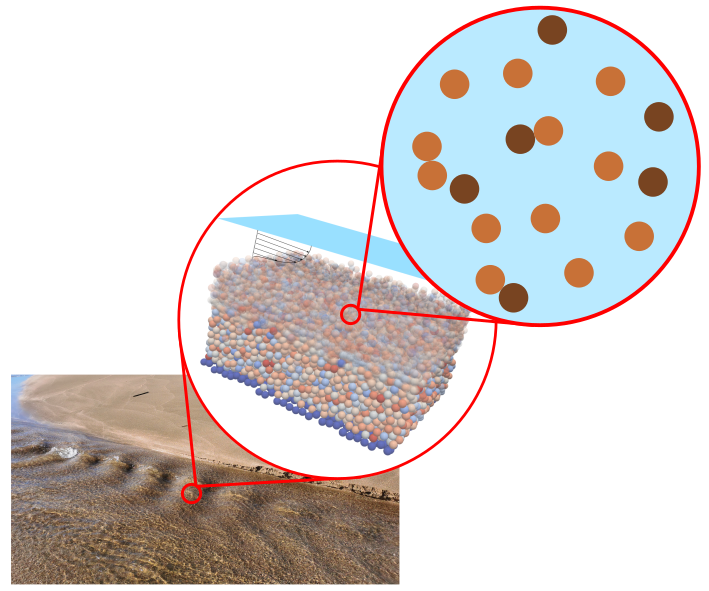
Sediment transport is an ubiquitous phenomenon in nature. Its accurate prediction relies on the understanding of multi-scale physics including the granular behavior of the sediment grains. Coupled fluid-discrete simulations allowed us to infer how particle-particle interactions govern the dynamics of the sediment phase, and we proposed a kinetic-theory model able to describe the granular behavior. In particular, we demonstrated that particle friction is crucial for describing such flows. This model is now implemented in the open-source sedFOAM code, a two-fluid solver for sediment transport.
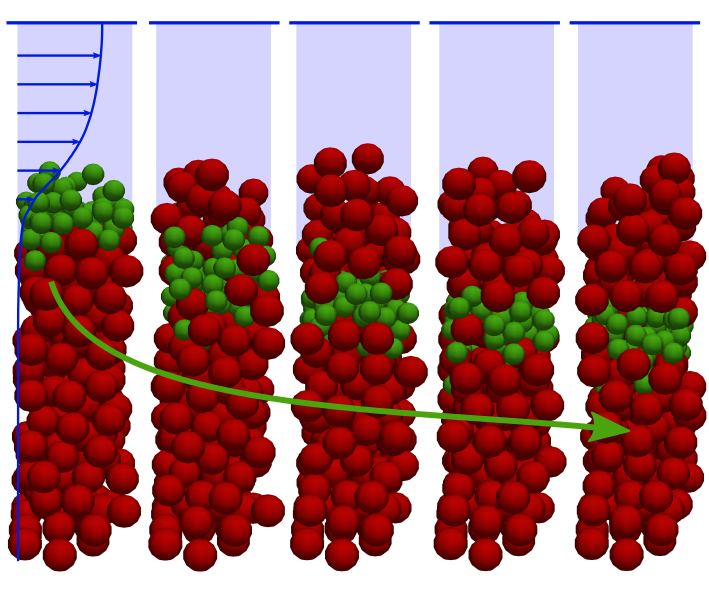
When a granular medium is sheared, particles of different sizes separate, small particles infiltrating the bed while large particles are rising to the surface. This phenomenon, still poorly understood, is of particular importance in sediment transport and may be one of the main reasons of our inability to predict sediment transport rate. It is therefore a main challenge to understand the dynamics of segregation and its impact on sediment transport. We approach this segregation problem at the particle scale with a coupled fluid-discrete element model (DEM). In this model, the individual motion of each particle is solved while the fluid flow is modelled with classical turbulent fluid equations. This model is precise and powerful and allows us to study the dynamics of infiltration of small particles (see figure). However it is very expensive in term of computational time and it is not possible to make large scale simulations. In that sense, we also develop continuum models to represent size segregation such as two phase flow models or advection-diffusion model, whose closures are based on the DEM simulations.

We also study the impact of size segregation on sediment transport, focusing on the mobility of bidisperse mixtures. Still using the coupled fluid-DEM model, we observe that the transport rate of already segregated beds is always higher than in monodisperse situations. The rheology of such bidisperse beds can be analysed to explain the increase of transport : because the particle diameter enters the definition of the inertial nmber, small particles are more mobile than larger ones and play the role of a 'conveyor belt' for the overlying large particles.
Such a configuration is a stable configuration, in the sense that large particles are above smaller ones. However, under some conditions depending on the size ratio and the Shields number, reverse segregation patterns can be observed with large particles forming trains of particles deep the bed. The bedload layer is therefore composed of a well mixed mixture of small and large particles. This can be analysed as a competition between segregation and diffusive remixing which in this case is controlled by diffusive remixing processes. This is an ongoing work.
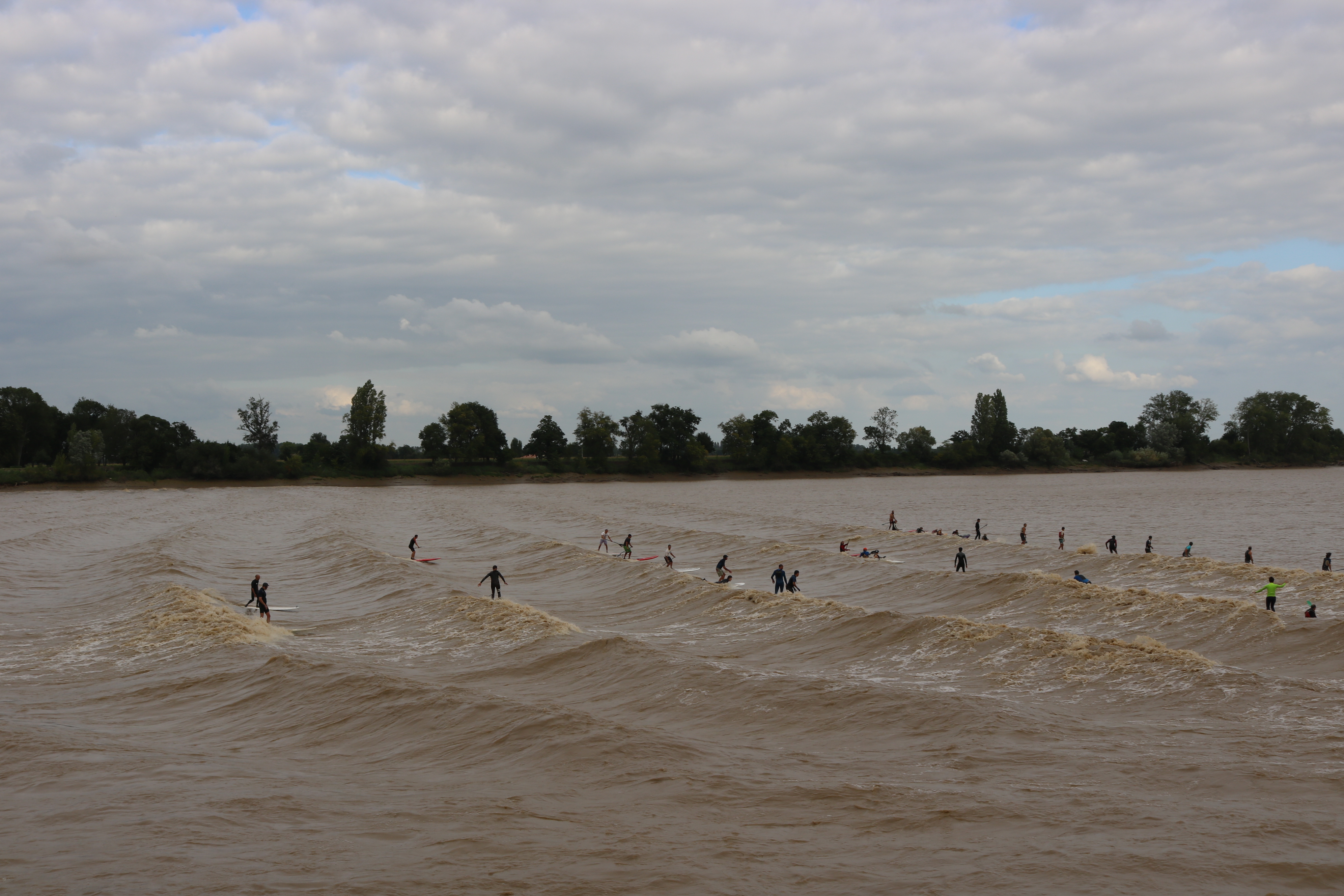
In collaboration with Philippe Bonneton (EPOC Bordeaux), Mario Ricchiuto (INRIA Bordeaux) and Andrea Filippini, I studied the formation and propagation of undular bores in channel with banks. In rivers, undular bores can form during the propagation of tidal waves close to estuaries or during dam breaks. They are quite remarkable in the Dordogne and Garonne rivers, close to Bordeaux, and well known by surfers enjoying beautiful waves propagating for several kilometers. Physically, they are well understood in rectangular channels, the wave formation being due to dispersive, non hydrostatic effects. The simple theory of Favre and the depth averaged equations of Serre-Green Naghdi (shallow water equations with small additional dispersive terms) represent very well the undular bore dynamics. When considering channels with banks, both field and laboratory experiments evidenced two different undular bore regimes, with two distinct wavelengths and amplitudes, that the classical theory cannot explain. During my internship, we have been able to show numerically and theoretically that refraction on the banks is responsible for dispersive-like effects and the creation of this second undular bore regime.